The Power of Silence: Let the Doodle Do the Selling For You
Introduction
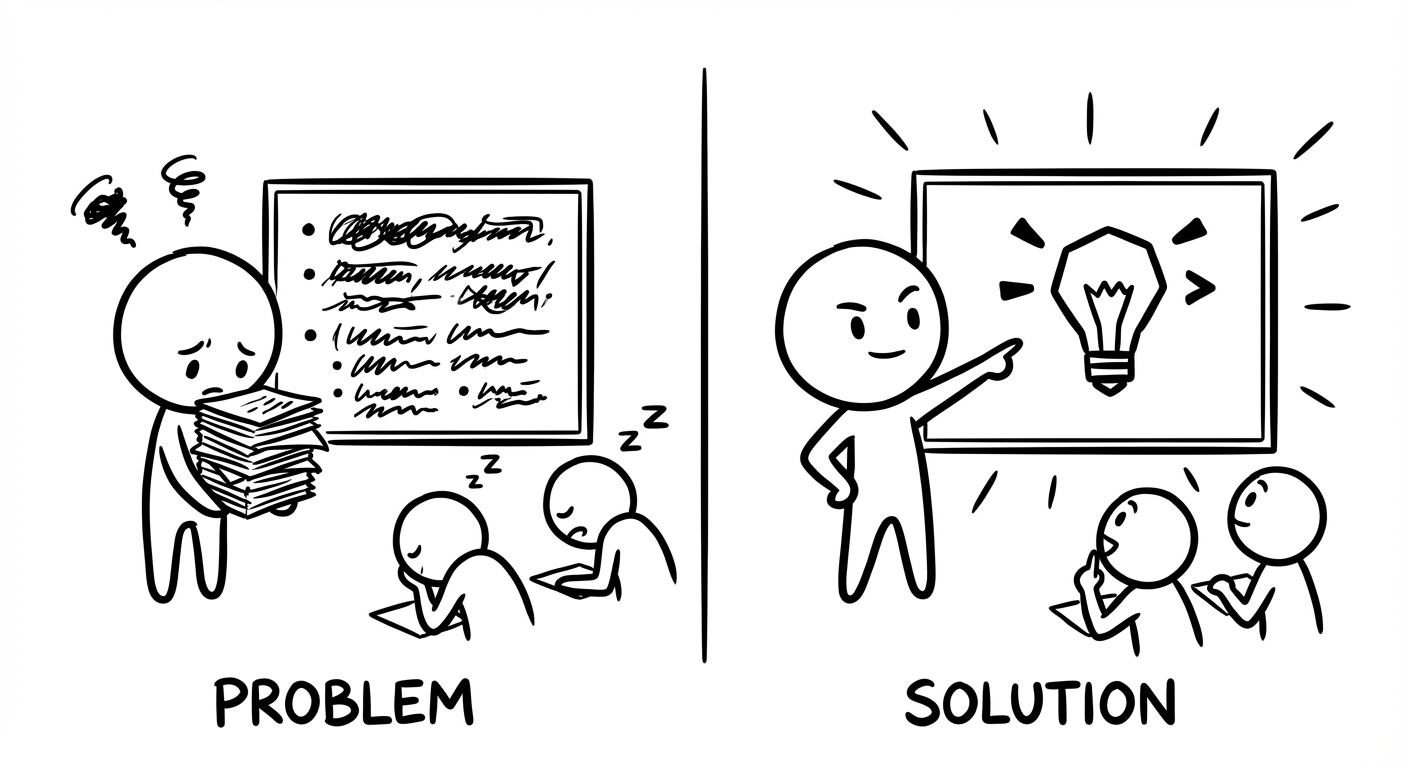
Picture this. You are three slides into your big pitch and you can feel the room slipping away. Eyes drift to phones. Someone opens their laptop. The decision‑maker glances at the clock and starts scrolling through emails. Your carefully written bullet points are on the screen, but no one is really there with you.
It is not that your idea is weak. It is that the format is working against your brain. People are drowning in words, decks, memos and chat threads. Their working memory is already overloaded before your meeting even starts. Add another wall of text, and the brain hits its own circuit breaker. It checks out. That is where a simple doodle can quietly do what more words cannot.
What if you could sketch the problem and the outcome in one simple picture, then stop talking? No drama. No performance. Just a clear doodle that shows how everything fits together while you give the room a few seconds of silence. The team with the tidy doodle on a whiteboard beats the team with the glossy deck.
This article is not theory from a textbook. It comes from thousands of hours watching what actually lands with real clients, students and senior leaders. By the end, you will understand why your brain loves quick visuals, what doodle selling looks like in practice, and how tools like Drawlah from Iwi Digital make visual‑first communication fast, repeatable and scalable. Then you can let the doodle, not your voice, do most of the selling.
Key Takeaways
A short summary helps when attention is tight. These points give the big ideas before you dive into the detail.
- Visuals move faster than text. Research points to processing speeds a lot quicker than reading. That speed changes how you pitch, teach and persuade. A single doodle can land meaning before a paragraph even gets started.
- Simple doodles lower mental strain. Sketching strips away padding and shows structure in one view. That lighter load means people remember the picture long after the meeting, often for 72 hours or more. Your message stays alive while others fade.
- Doodle selling matches how memory works. It ties images and short labels together. This matches dual coding theory, where verbal and visual channels store the same idea. With two routes into memory, recall is easier under pressure. That pays off in exams, boardrooms and sales calls.
- Modern tools such as Drawlah make visuals a habit. Ready‑made shapes and templates speed things up. Automation features help you produce many versions of a doodle without starting from scratch each time. Time pressure and design worries stop being excuses.
- Hand‑drawn style visuals often beat corporate slides. Icons and quick diagrams pull people in. They lean forward, ask questions and point at parts of the doodle. Polished decks may look safe, but they rarely trigger that kind of active response.
Why Your Words Are Failing You (And Your Brain Knows It)
You live in what many call an attention crisis. Messages ping all day. Meeting invites pile up. Long emails fight for space with endless chat threads. In that noise, a 20‑slide deck or a three‑page memo has very little chance. Most readers skim the first few lines, pick up one detail, then move on. Your careful wording barely gets a look.
The reason sits in basic cognitive science. Your working memory is small. Every sentence you read demands a chain of steps:
- decode symbols on the screen
- stitch them into words
- attach meaning to those words
- build a mental picture that fits them together
That is a lot of effort before understanding even begins. When you ask someone to do that across a dense slide, their brain simply gets tired and checks out.
Bullet‑pointed slides make this worse, not better. On the surface they look neat and structured. Underneath, they force the brain to hop from line to line with no clear visual anchor. Each bullet competes for attention with the rest. In many boardrooms across Kuala Lumpur and the rest of the world, you will see the same thing. The moment the fifth bullet appears, eyes drift to phones. The deck has turned into wallpaper.
Now think about the last time someone walked to a whiteboard instead. They drew three boxes, added arrows between them, and wrote a few key words. The room shifted. People watched the hand move. They could see the whole idea laid out in space. No one needed to remember sentences. They only needed to remember the small doodle and the story that sat on top of it.
Studies back this up. Information shared in a visual way is far more likely to be retained than text alone. When people both hear a message and see a simple picture of it, recall shoots up days later. If your words keep failing to land, the issue is not your intelligence or your intent. It is that the format is fighting your brain. The alternative starts with a pen, a few shapes and a quiet pause.
“Vision trumps all other senses.”
— John Medina, Brain Rules
What Is Doodle Selling? (The Art of Letting Visuals Lead)
Doodle selling means putting simple sketches at the centre of how you explain value. It is the habit of reaching for boxes, arrows, stick figures and icons before you reach for long paragraphs. A doodle in this sense is not a random scribble in the margin. It is a quick, clear visual that shows the problem, the path and the outcome on a single page.
The heart of doodle selling is silence used with intent. In many pitches, the presenter talks non‑stop. They rush to fill every gap with more detail. With doodle selling, you flip that pattern. You draw the scene, add a few short labels, then stay quiet for a moment. You let people read the doodle with their own eyes. Their brains start to work on the picture, often much faster than your voice could manage.
You do not need any formal art skill to do this well. In fact, a doodle that looks too perfect can feel distant and stiff. A slightly wobbly box or sketchy line feels human. It signals that you are thinking on the spot, with this group, about their real issue. That builds trust. It tells the room, “This was made for you, not recycled from the last ten pitches.”
A good doodle creates an “aha” moment far quicker than a speech. For example, three simple stages with arrows can show a whole service flow. A tiny stick figure at the start and a smiling one at the end can show how a customer’s day changes. Instead of explaining that flow for ten minutes, you can point once and ask, “Does this match what you see?” Speed to understanding becomes your edge.
This is very different from dropping stock photos into slides or sending long infographics. Stock images hardly say anything about your idea. Heavy infographics can overwhelm. Doodle selling is about minimal, focused visuals that guide attention exactly where you want it. When you start to think this way, meetings shift from endless talk to shared drawing. That is where your doodle starts doing the selling for you.
“Whoever best describes the problem is the one most likely to solve it.”
— Dan Roam, The Back of the Napkin
The Neuroscience of Doodles: Why Simple Sketches Outsell Polished Slides
When you strip away buzzwords, doodle selling rests on a few clear findings from psychology and neuroscience. Your brain has specific channels for taking in and storing information. Simple sketches line up with those channels in a way that formal text and glossy graphics do not. Understanding this helps you design visuals that stick.
Dual Coding Theory: Two Pathways Are Better Than One

Allan Paivio’s dual coding theory explains that your brain stores information in two broad systems. One handles language. The other handles images. When you present an idea only in words, you rely on one path. When you combine a doodle with short labels or spoken comments, you give the brain two paths into the same concept.
Think about a quick canvas you might create in Drawlah. You sketch three circles for “Now”, “Next” and “Later”, then add a few words to each. Your client hears you speak, sees the doodle and reads the labels. Their visual system and verbal system both get involved. That double imprint makes the idea much easier to recall days later, especially under stress.
This is why clients often remember a simple diagram from a meeting more clearly than the written report that followed. The doodle gives their memory a clear anchor point. The words then hang off that anchor.
Visual Processing Speed: 6 to 600 Times Faster

Your brain is built to scan scenes quickly. Studies show that people can grasp the gist of an image in a few dozen milliseconds. Reading takes far longer, because each word must be processed in sequence. That gap in speed is not small. It can be hundreds of times in favour of the visual route.
In a pitch or a classroom, this speed matters. Attention peaks for a brief window when a new slide appears or when you switch topics. If you fill that moment with a dense paragraph, much of the power is wasted. If you fill it with a clean doodle, people “get” the message almost at once. You can then use your voice to add colour and answer questions rather than to carry all the load.
When you know that a quick doodle can outpace a paragraph so dramatically, it starts to feel careless not to use one.
Reducing Cognitive Load: The Brain's Gratitude
Cognitive load theory reminds you that the brain can only handle a limited amount of new material at once. Long lists, nested bullet points and crowded diagrams drain that capacity quickly. When load rises too high, learning stops. People may look attentive, but very little is going in.
A well‑designed doodle respects that limit. It uses white space, simple lines and clear groupings so that the structure of the idea is obvious:
- steps appear in a clear order
- related points sit close together
- unneeded decoration is left out
Nothing fights for attention. The brain barely has to work. It can move straight to “What does this mean for me?” instead of “What am I even looking at?”
Research into doodling during dull tasks backs this up, with studies like Exploring the doodle toolkit demonstrating measurable cognitive benefits. In Jackie Andrade’s study, people who doodled while listening to a boring recording remembered nearly a third more details than those who did not. The simple act of sketching shapes held the mind in a light focus state. It stopped them drifting into full daydreams and kept more information flowing through.
The Emotional Connection: Imperfection Breeds Trust
Communication is not only about logic. It is also about how people feel about you while you speak. Highly polished slides can look impressive, but they also create distance. They hint at long approval chains and spin. Many people have learnt to brace when they see them.
A hand‑drawn doodle has the opposite effect. It feels like a live thought rather than a rehearsed pitch. Small imperfections in the lines or handwriting remind people that a real human is thinking this through with them. Social psychology research shows that small, honest flaws can increase likeability. In a meeting, that can soften resistance and invite more open questions.
When you pick up a pen or open Drawlah and sketch in real time, you are also giving away some control. You show your thinking process, not just the final product. That transparency builds comfort. People trust the message more because they have watched it take shape.
You can think of the science behind doodle selling in three simple ideas:
Principle | What It Means for Your Doodles |
Dual coding | Pair visuals with short words for stronger recall |
Processing speed | Let pictures carry the first hit of meaning |
Cognitive load limits | Keep sketches sparse so the brain can breathe |
The evidence leans heavily in one direction. Your brain prefers simple, clear visuals supported by short words. The only question left is how you bring that into your day‑to‑day work.
How to Apply Doodle Selling in Your Business (Tools, Tactics, and Real Examples)
Knowing that doodles work is one thing. Building them into your meetings, teaching and content is another. The good news is that you can start small, with the tools you already have like mini diagrams on your post-its, and then move into more advanced options like Drawlah when you are ready.
Start With Purpose, Not Perfection

Before you draw anything, ask a single question: What is the one idea this person must walk away with? That idea might be “We reduce your risk,” “This course will double your exam recall,” or “Your customer gets from stress to calm in three steps.” Your doodle should focus on that and leave the rest out.
A simple way to plan is:
- Write your one‑sentence core message.
- Break it into two or three stages or parts.
- Assign one box, circle or icon to each stage.
- Add a short label under each shape.
Resist the urge to cram in every detail. A doodle is not a mini report. It is a signpost. Three boxes with arrows are often enough. One simple icon per stage is often enough. If you find yourself adding tiny text everywhere, pause and strip it back. The power of a doodle sits in what you choose not to draw.
Practical Use Cases Across Your Business
Once you are clear on purpose, you can bring doodle selling into many parts of your work. These examples are all drawn from patterns Iwi Digital has seen with clients and students.
1. Client Pitches and Sales Presentations
In a pitch, you often have only a few minutes of real attention. Instead of warming up with your company history slide, open with a doodle of the client’s current state and desired state. On one side, sketch their stressed customer. On the other, sketch the calmer, happier version. In between, draw your three key moves.
With Drawlah, you can prepare that doodle once, then adjust it for each client without redrawing from scratch. The tool gives you a hand‑drawn look, but you can nudge shapes, change colours and swap icons quickly. When you share the doodle on screen and then pause, you invite the client to talk. They point at parts of the picture. They correct, add and engage. The selling becomes a shared act.
2. Internal Team Workshops and Brainstorming
Teams often get stuck in loops of abstract talk. People repeat the same points in different words. Progress feels slow. In that moment, moving to a doodle can cut through the fog. Draw the current process as a simple path. Mark where work piles up. Mark where hand‑offs fail.
Doing this live on a whiteboard or with doodles from Drawlah during your video call shifts the mood. Instead of arguing in the air, your team can now point to a stage and say, “This is where things go wrong.” New ideas feel more grounded when everyone can see where they fit. You gain alignment much faster because the doodle keeps the discussion anchored.
3. Marketing Content and Social Media
A feed full of stock photos and long text updates is easy to scroll past. A simple doodle has a better chance of stopping the thumb. For example, you could sketch three small buckets labelled “Onboarding”, “Habits” and “Support” to show your retention model. One image like that on LinkedIn or Instagram tells a clearer story than another paragraph of copy.
Drawlah works well here because you can turn that one core doodle into many variants. Swap labels for different segments. Change a colour to match a campaign. Automatically output formats for different platforms. Instead of spending hours in a design tool, you keep the raw, hand‑drawn feel while still moving at social media speed.
4. Complex Data Presentation (Reports, Analytics, BI)
Data teams often complain that no one reads their reports. Stakeholders open a dashboard, feel lost and close it. Before you show any dense chart, sketch a high‑level doodle of what the data is saying. For instance, you might draw a simple line rising over three quarters, with one dip and a note asking “What happened here?”
This light sketch gives context before the numbers appear. People know what to look for on the big chart, and they feel less overwhelmed. The same idea applies in board papers and exam revision. A doodle that states “This is the story in the numbers” prepares the mind to pay attention.
Building Visual Fluency in Your Team
Doodle selling becomes easier when it is part of your culture rather than a one‑off trick. Encourage people in meetings to stand up and sketch their point instead of explaining it three times. Put marker pens and sticky notes in every room. In online settings, keep a canvas or digital whiteboard open by default.
You can also run short practice sessions:
- Teach your team five basic shapes and a small set of icons like people, buildings and screens.
- Ask each person to doodle a process they know well, then explain it using only that picture.
- Rotate who leads the sketch in regular meetings so the habit spreads.
After a few rounds, even the most “non‑artistic” people start to enjoy it. The energy in meetings shifts from passive listening to active mapping.
When leaders model this habit, it spreads faster. If you, as the founder, C‑suite leader or teacher, reach for a doodle first, you give silent permission for others to do the same. Over time, your organisation becomes known for clear thinking shown in clear pictures. That is a powerful signal in any high‑pressure setting.
Drawlah and the Future of Visual-First Communication Tools
Doodle selling is easier when the right tools fit neatly into your existing work. That is why we created Drawlah, a digital doodle app built for thinkers.
Why Drawlah Exists: Solving a Real Pain Point

Dom, the creator of Drawlah, spent years watching presentations collapse in real rooms. He saw smart founders and consultants lose senior audiences within minutes. The pattern was clear. Too many words. Too many slides. Not enough simple visuals. He wanted the feel of sketching on a whiteboard with the practical benefits of a digital file.
Drawlah was born from that need. The aim was simple: help people move their audience from confusion to clarity in seconds, not hours. Behind that sits a bigger goal. Iwi Digital wants to help a million ideas that deserve attention cut through the noise by giving them a clear, memorable doodle.
“Good design is clear thinking made visible.”
— Edward Tufte
What Makes Drawlah Different
Many drawing apps are aimed at designers or illustrators. Drawlah is different. It is built for business owners, lecturers, strategists and students who think in frameworks. The tools inside the app are simple on purpose. Lines, shapes, arrows and text all default to a hand‑drawn style that feels like pen on paper.
At the same time, you are not stuck with whatever you draw first. You can move pieces, resize elements, tweak colours and export clean images for decks, PDFs or social posts. Dynamic Doodles help you start from a proven layout, then adapt it to your own presentation. AI features let you create many personalised doodles from one base design, which is powerful for campaigns and reports.
Real-World Results
Iwi Digital has seen Drawlah used in high‑stakes board meetings in Malaysia and classrooms online. Again and again, the feedback is similar. People remember the doodle. They quote it back days later. Deals move faster because decision‑makers can see the full picture quickly.
In teaching, students use Drawlah canvases as revision maps, a practice supported by findings on Doodling Effects on Junior High School Students' Learning which show improved retention through visual note-taking. Instead of pages of notes, they redraw key concepts as small doodles. When exam day arrives, they can “see” the canvas in their mind and rebuild the detail from there. That is dual coding at work in a very practical way.
The Broader Visual-First Toolset
Drawlah sits alongside tools like Miro, Mural and Figma in a wider move towards visual‑first work. Those platforms focus heavily on design and product teams. Drawlah focuses on business storytelling and persuasion. It aims to be the quickest path from “I have an idea” to “Here is a doodle that makes sense to someone else.”
As automation and AI expand, the ability to create personal visuals at scale will matter more and more. Iwi Digital is building Drawlah so that you can plug it into your flows, from video calls to proposals. The future belongs to people who can sketch ideas as easily as they write them. Drawlah exists to make that shift as smooth as possible.
Conclusion
Words still matter, but they can no longer carry your whole message on their own. Attention is limited. Working memory is small. In that setting, silence paired with a clear doodle becomes one of your strongest tools. You do not need to talk more. You need to show better.
The science is already on your side. Visuals are processed faster than text, stored in more than one channel and remembered for longer. Simple sketches reduce mental effort instead of adding to it. Slight imperfections even help people feel closer to you. All of that turns a quick doodle into a serious edge in sales, teaching and leadership.
You do not need drawing talent or a design budget to start. A pen and a page can take you far. Tools like Drawlah from Iwi Digital simply make the habit easier to keep. They let you reuse your best doodles, share them cleanly and scale them across teams and campaigns.
In the end, doodle selling is more than a trick for better slides. It is a mindset. It respects how the brain really works. It treats your audience’s time and attention as rare resources. After many hours in real rooms, one pattern stands out. The person who can sketch the problem and the path on a whiteboard usually owns the room. So for your next pitch or class, open a canvas, draw three boxes and two arrows, then pause. Let the doodle do the selling.
FAQs
Question 1: I'm Not Artistic. Can I Really Use Doodle Selling Effectively?
Yes, you can. Doodle selling is about clear thinking, not fancy drawing. If you can draw a box, a circle, a triangle, a line and an arrow, you already have enough shapes to explain most business ideas. In many rooms, simple stick figures and rough icons actually feel more honest than polished art. Tools like Drawlah by Iwi Digital help even more, because they give your rough doodles a neat hand‑drawn style without asking for any drawing skill.
Question 2: How Long Does It Take to Create a Doodle for a Presentation?
Once you know your main message, a useful doodle often takes five to fifteen minutes. You spend a couple of minutes choosing the key stages or parts, then a few more sketching them as boxes or icons with short labels. The aim is one idea per doodle, not a whole report.
Question 3: When Should I Use Doodles Instead of Traditional Slides?
Doodles shine whenever you need to make something complex feel simple. That includes client pitches, internal strategy sessions, project kick‑offs, teaching tricky topics and explaining data headlines. Any time you want people to see relationships, flows or cause‑and‑effect, a doodle will usually beat a text slide. For very detailed financial tables or legal wording, you still need traditional formats for accuracy. Even then, opening with a quick doodle summary sets the scene and gives people a map before they face the detail.
Question 4: Can I Use Doodles in Formal Business Settings, or Will They Seem Unprofessional?
You can use them, and they often raise the level of the discussion. Major consulting firms and top lecturers rely on simple frameworks and hand‑drawn models all the time. In a formal boardroom, a quick doodle on a flip chart or in Drawlah can signal confidence. It says you know the material well enough to strip it down. The key is intent. Frame it as “Let me map this out so we can all see it,” and people will usually welcome the clarity rather than question the style.
Question 5: What Tools Do You Recommend for Digital Doodling?
For business use, Drawlah is a strong starting point, because it was built specifically for visual explanations in sales, teaching and strategy. It offers a natural doodle look with the convenience of digital editing and export. For live workshops, shared whiteboard tools such as Miro or Microsoft Whiteboard are helpful. If you use a tablet, note apps with pen support are also helpful for personal sketching. The best choice is the one that fits smoothly into how you already meet, teach and share.